Hi, this is Alex and this is my BOB post for the combinatorics' test. I found that I caught on to this unit fairly fast. For some reason it was easy for me to understand it. A big part of my understanding was due to the connections Mr.K made to real life with this unit. The poker questions were confusing but very helpful. I think another reason I found this unit easier to understand was, every question had visual components to them. So, if a question asked you how many ways can you sit 5 people in 6 chairs, you could, or at least I could, easily picture this in my mind and I found it very helpful.
What also helped me understand this unit was the discussions we had in class. This unit I asked many questions and everything that was confusing me was clarified easily because of this.
Now, all there's left to do is practice some questions and improve my confidence with these types of problems.
If I could make on possible suggestion to Mr.K, it would be to hand out some optional math worksheets for this unit. Just because, I found the exercises a bit repetitive and having that bit of extra practice, I think, would be very helpful.
Well, I hope everyone did WonderfullyExcelent on their tests on Friday, and I hope I do on Tuesday.
Showing posts with label Combinatorics. Show all posts
Showing posts with label Combinatorics. Show all posts
Friday, May 15, 2009


Thursday, May 14, 2009
BOB
Late bob .. sorry! I just got home from work an hour ago .
Anyway, this unit was easy in the beginning. I mean, it was really easy to understand. The thing the threw me off was the poker part of the unit. I dont even know the poker hands.. Up until last week I thought that I was doing well in this unit. But now, im not so sure .
I guess that there are alot of things we should know for the test tomorrow. Like, knowing which formula to use.... the choose formula or the pick formula. There's also the formula that we use if there are non-distinguishable objects, and circular permutations. I really think that we should've spent more time on the poker questions, because thats the thing that's really bugging me.
Well, I have a lot of studying to do.
Good luck on the test everyone!
Anyway, this unit was easy in the beginning. I mean, it was really easy to understand. The thing the threw me off was the poker part of the unit. I dont even know the poker hands.. Up until last week I thought that I was doing well in this unit. But now, im not so sure .
I guess that there are alot of things we should know for the test tomorrow. Like, knowing which formula to use.... the choose formula or the pick formula. There's also the formula that we use if there are non-distinguishable objects, and circular permutations. I really think that we should've spent more time on the poker questions, because thats the thing that's really bugging me.
Well, I have a lot of studying to do.
Good luck on the test everyone!
BOB on Permutations and Combinations
Sup y'all~ Here I am BOB-ing the night before our scheduled unit test, however I'm not quite sure if I am writing the test tomorrow, so I shall BOB anyway!
What can I say about this unit?
Well, it's certain that I found it a lot easier than Logarithms! I actually got the hang of it at first, I even predicted (n-1)! However, things got trickier and trickier~
The concepts I had a hard time grasping were the table problems and the poker hands (mainly because I'm terrible at card games and am extremely unfamiliar with these "hands!")! So I definitely need to practice those...
What I learned from this unit is to create and utilize even more clever ideas! Without them, this unit would be a big toughie! So remember, read the question carefully, know what it's asking for, and think of a clever way to find a solution!
Also, those necklaces and bracelets! Keep in mind that those things can be turned over and result in a permutation that you've already come up with before. So, you must divide your answer by two! OH! This does not apply to tables lol. Because you can't turn a table over when there are people sitting there, that's just rude.
Hmm.. what else?
Well, with permutations, order matters...
However, with combinations, order does not matter!
Don't forget about the "Pick" (nPr) and "Choose" (nCr) formulas and when they are appropriate to use!
Well, isn't this BOB post all over the place :/
Oh well!
Oooh, don't forget about using them bags, they're quite helpful, but also - don't forget that the objects within each bag still have a number of ways to be rearranged!
Speaking of objects, don't forget about distinguishible and non-distingquishable objects!
That is... (n!)/(k1!)(k2!)(k3!)
Where n = number of objects and k1, k2, k3 are the numbers of each non-distinguishable object!
Aw man, I'm BOB'd out. Sorry if I missed anything, every else had already made such awesome posts anyway!
Good luck everyone! Do your best!
What can I say about this unit?
Well, it's certain that I found it a lot easier than Logarithms! I actually got the hang of it at first, I even predicted (n-1)! However, things got trickier and trickier~
The concepts I had a hard time grasping were the table problems and the poker hands (mainly because I'm terrible at card games and am extremely unfamiliar with these "hands!")! So I definitely need to practice those...
What I learned from this unit is to create and utilize even more clever ideas! Without them, this unit would be a big toughie! So remember, read the question carefully, know what it's asking for, and think of a clever way to find a solution!
Also, those necklaces and bracelets! Keep in mind that those things can be turned over and result in a permutation that you've already come up with before. So, you must divide your answer by two! OH! This does not apply to tables lol. Because you can't turn a table over when there are people sitting there, that's just rude.
Hmm.. what else?
Well, with permutations, order matters...
However, with combinations, order does not matter!
Don't forget about the "Pick" (nPr) and "Choose" (nCr) formulas and when they are appropriate to use!
Well, isn't this BOB post all over the place :/
Oh well!
Oooh, don't forget about using them bags, they're quite helpful, but also - don't forget that the objects within each bag still have a number of ways to be rearranged!
Speaking of objects, don't forget about distinguishible and non-distingquishable objects!
That is... (n!)/(k1!)(k2!)(k3!)
Where n = number of objects and k1, k2, k3 are the numbers of each non-distinguishable object!
Aw man, I'm BOB'd out. Sorry if I missed anything, every else had already made such awesome posts anyway!
Good luck everyone! Do your best!
BoB oh BoB
Hello. This last unit was called combinatorics and I found it very interesting because there are so many different ways and different ways of thinking that we can solve problems with. This is the kind of math we could use in every day situations. First things first, definitions:
Combination: In combinatorial mathematics, a combination is an un-ordered collection of distinct elements, usually of a prescribed size and taken from a given set.
Permutation:In combinatorics, a permutation is usually understood to be a sequence containing each element from a finite set once, and only once

(Wikipedia definitions)
It is very crucial to understand these terms.
For me, everything in this unit went swimmingly well until we learned about this:

oh boy... But I realized after we did some questions, and with further exploring this, everything went a whole lot better...

That is pascals triangle. Don't forget some nifty tricks in the triangle, like 2^x rule and how it corresponds with the row number, and the 11^x, and also the good old hockey stick pattern.
To view all possible poker hand probabilities, go to this link!
I didn't find much trouble with the poker hands because I'm a big fan of the game.
Well this sums up my bob post, the next bob is bob by the way!
Combination: In combinatorial mathematics, a combination is an un-ordered collection of distinct elements, usually of a prescribed size and taken from a given set.
Permutation:In combinatorics, a permutation is usually understood to be a sequence containing each element from a finite set once, and only once
(Wikipedia definitions)
It is very crucial to understand these terms.
For me, everything in this unit went swimmingly well until we learned about this:


oh boy... But I realized after we did some questions, and with further exploring this, everything went a whole lot better...
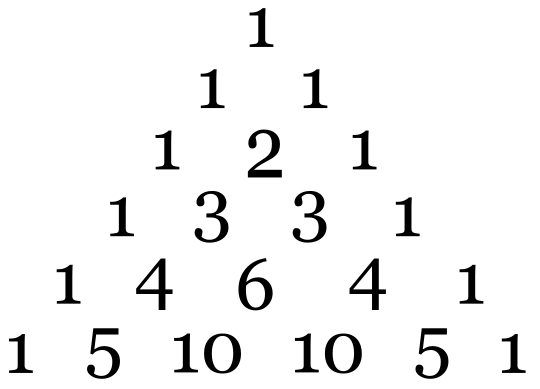
That is pascals triangle. Don't forget some nifty tricks in the triangle, like 2^x rule and how it corresponds with the row number, and the 11^x, and also the good old hockey stick pattern.
To view all possible poker hand probabilities, go to this link!
I didn't find much trouble with the poker hands because I'm a big fan of the game.
Well this sums up my bob post, the next bob is bob by the way!
Bob has a Perm ;D
This unit wasn't that bad, but I've had my down moments. Heck, i have had many more down moments with this unit then happy up moments but that's OK... well not really.
I'll start off with how I feel about this test tomorrow: Not that great. I thought I understood everything before I entered that classroom today but the pretest was... confusing, and the cards! OH MY GAWSH, the cards... I'm not a big fan of them, but I will learn to love them.
Here are some wonderful pieces of useful information that should be useful:
1. A PERMUTATION is used when ORDER MATTERS. The lock on your locker is a permutation lock because the order the numbers are chosen effects whether the lock opens or not. For example the combo 17-4-56 is not the same as 56-17-4.
The formula you would use would be nPr - read as n pick r - where n is the number of objects to pick from and r is the number of objects that need to be arranged.
If you have non-distinguishable objects (like repeated letters in a word that you want to rearrange), then n!/k1!k2!k3!... where n is the number of letters in the word and k is the number of repeated objects.
2. A COMBINATION is different from a permutation. This is when order DOES NOT MATTER. Picking people for committees is an example of a combination because there are no places or ranks to order them in.
The formula you would use is nCr - which is read as n choose r - where n is the total number of objects and r is the number of objects you want to choose for you combo.
3. The FUNDAMENTAL PRINCIPLE OF COUNTING should have been first on my list but oh well... it's when you have p number of things and q number of things and u multiply them together, you'll get the number of possible combinations. Yay!
The ! means factorial. Factorial means that you multiply a nunber by every number below it until 1. So 5! would be 5x4x3x2x1.
4. CIRCULAR PERMUTATIONS are when you must rearrange things in a circle. The formula for this is (n-1)! because one object is the starting point and it does not count.
There are SPECIAL CASES like when the circle is a bracelet or a necklace because you can flip it over. For these cases the formula would be (n-1)!/2
5. For objects that MUST ALWAYS STICK TOGETHER (people wanting to sit together, certain books have to be side by side etc.), but those objects in a bag and count the bag as one object. Figure out the number of possible ways to arrange those objects. Then find the number of ways to arrange the objects inside the bag. Then multiply the two answers together to get the final answer... does that make any sense ? Well it does to me. :D
6. The BINOMIAL THEOREM can blow your mind away. It can find a specific term in a binomial expansion without actually expanding the whole binomial. Here is the formula:
 i is the term you want.
n is the exponent
a is the first term and b is the second in (a+b)^n
WHEN LOOKING FOR THE MIDDLE TERM. IF THE NUMBER OF TERMS OF THE EXPANSION IS EVEN THERE IS NO MIDDLE TERM. REMEMBER THAT.
7. Pa-pa-pa-poker face, pa-pa poker face [8]. Cards. Yeah. Look at aldrin's and john's BOBs, they have that covered... I can't really explain it becuase i don't really know it.
I hope I have everything covered. If I don't please don't hesitate to tell me. Or if I have something wrong.. correct me ;D
I hope I don't fail tomorrow.
BREAK A PENCIL EVERYONE ;D
I'll start off with how I feel about this test tomorrow: Not that great. I thought I understood everything before I entered that classroom today but the pretest was... confusing, and the cards! OH MY GAWSH, the cards... I'm not a big fan of them, but I will learn to love them.
Here are some wonderful pieces of useful information that should be useful:
1. A PERMUTATION is used when ORDER MATTERS. The lock on your locker is a permutation lock because the order the numbers are chosen effects whether the lock opens or not. For example the combo 17-4-56 is not the same as 56-17-4.
The formula you would use would be nPr - read as n pick r - where n is the number of objects to pick from and r is the number of objects that need to be arranged.
If you have non-distinguishable objects (like repeated letters in a word that you want to rearrange), then n!/k1!k2!k3!... where n is the number of letters in the word and k is the number of repeated objects.
2. A COMBINATION is different from a permutation. This is when order DOES NOT MATTER. Picking people for committees is an example of a combination because there are no places or ranks to order them in.
The formula you would use is nCr - which is read as n choose r - where n is the total number of objects and r is the number of objects you want to choose for you combo.
3. The FUNDAMENTAL PRINCIPLE OF COUNTING should have been first on my list but oh well... it's when you have p number of things and q number of things and u multiply them together, you'll get the number of possible combinations. Yay!
The ! means factorial. Factorial means that you multiply a nunber by every number below it until 1. So 5! would be 5x4x3x2x1.
4. CIRCULAR PERMUTATIONS are when you must rearrange things in a circle. The formula for this is (n-1)! because one object is the starting point and it does not count.
There are SPECIAL CASES like when the circle is a bracelet or a necklace because you can flip it over. For these cases the formula would be (n-1)!/2
5. For objects that MUST ALWAYS STICK TOGETHER (people wanting to sit together, certain books have to be side by side etc.), but those objects in a bag and count the bag as one object. Figure out the number of possible ways to arrange those objects. Then find the number of ways to arrange the objects inside the bag. Then multiply the two answers together to get the final answer... does that make any sense ? Well it does to me. :D
6. The BINOMIAL THEOREM can blow your mind away. It can find a specific term in a binomial expansion without actually expanding the whole binomial. Here is the formula:
 i is the term you want.
n is the exponent
a is the first term and b is the second in (a+b)^n
WHEN LOOKING FOR THE MIDDLE TERM. IF THE NUMBER OF TERMS OF THE EXPANSION IS EVEN THERE IS NO MIDDLE TERM. REMEMBER THAT.
7. Pa-pa-pa-poker face, pa-pa poker face [8]. Cards. Yeah. Look at aldrin's and john's BOBs, they have that covered... I can't really explain it becuase i don't really know it.
I hope I have everything covered. If I don't please don't hesitate to tell me. Or if I have something wrong.. correct me ;D
I hope I don't fail tomorrow.
BREAK A PENCIL EVERYONE ;D
BOB for Combinatorics
Hi everyone, it's Trinh and the BOB for combinatorics unit.
At first in this unit, i got some troubles because i sometimes misunderstood the questions but now i think i am ok with it.
I think in this unit, we have to read the questions and think about it carefully, remember the pick and choose formula, remember the formula of how to arrange things on a circle and especially for the bracelets and necklaces.
Anyway, good luck on your test guys.
Don't forget your Delicious link..
At first in this unit, i got some troubles because i sometimes misunderstood the questions but now i think i am ok with it.
I think in this unit, we have to read the questions and think about it carefully, remember the pick and choose formula, remember the formula of how to arrange things on a circle and especially for the bracelets and necklaces.
Anyway, good luck on your test guys.
Don't forget your Delicious link..
What cha doing up at 5am BOB?
Howdy y'all, I'm finally finished my English and now I get to do my BOB. This unit was really quick, but I like this unit. I'm more of a word problem solver than a numbers person. With that being said I'm still working of the binomial theorem and all those other more number related things. I'm feel good for the test but usually when I feel that . . . . dun dun dun comes later when i get my test back.
So some quick things we should remember:
-For permutations order matters!
-For combination's order does not matter!
-For things that have to be together it is be to "put it in a bag"
-Look out for repetitions
-Remember bracelets and necklaces can be flipped
-For circle permutations it doesn't matter where you start, so glue a person to the floor.
Sorry if this doesn't make any sense at all but I'm really tired, I don't think I'm gonna get any sleep today and I can hear wind chimes. Its giving me the hebe geebees
Over and Out
- jennifer
So some quick things we should remember:
-For permutations order matters!
-For combination's order does not matter!
-For things that have to be together it is be to "put it in a bag"
-Look out for repetitions
-Remember bracelets and necklaces can be flipped
-For circle permutations it doesn't matter where you start, so glue a person to the floor.
Sorry if this doesn't make any sense at all but I'm really tired, I don't think I'm gonna get any sleep today and I can hear wind chimes. Its giving me the hebe geebees
Over and Out
- jennifer
BOBBY!
I'll start by saying this unit went too fast! But it was pretty straight forward. Many things like the "pick" or "choose" formula are things I might need to remember since I keep forgetting them in class. I'm also really nervous about the word problems. Since Mr.K can dish out some mean word problems xD.
Many things I learned:
1. Permutation is where the order matters. Combination is where the order doesn't. (That's why Mr.K says a combination lock should really be called a permutation lock.) :P
2. When there is a Permutation we use the "pick formula" and when there is a combination we use the "choose formula."
3. The Pick formula is P(n,r) = (n!) / (n-r)!
n= number of objects to pick from
r= how many objects you pick from the total.(order matters)
4. The choose formula is C(n,k) = (n!) / k!(n-k)!
n= number of objects to choose from
k= how many objects you choose from the total. (order doesn't matter)
5. With circular permutations its (n-1)! to find the possibilities.
6. 0! is 1
7. non distinguishable objects = (n!)/(k1!)(k2!)(k3!)..........
for example the word BOB has 2 b's but they look exactly alike so if you wanted to find how many words can be spelled...
3!/2! = 3
8. Bracelets and necklaces are special. You need to divide the result by 2 because it can be flipped over.
This unit will definitely be interesting and I will study hard for this one. There are still many things I need to master before I consider myself an expert on this topic. So hopefully I'm a master by Friday :D.
Many things I learned:
1. Permutation is where the order matters. Combination is where the order doesn't. (That's why Mr.K says a combination lock should really be called a permutation lock.) :P
2. When there is a Permutation we use the "pick formula" and when there is a combination we use the "choose formula."
3. The Pick formula is P(n,r) = (n!) / (n-r)!
n= number of objects to pick from
r= how many objects you pick from the total.(order matters)
4. The choose formula is C(n,k) = (n!) / k!(n-k)!
n= number of objects to choose from
k= how many objects you choose from the total. (order doesn't matter)
5. With circular permutations its (n-1)! to find the possibilities.
6. 0! is 1
7. non distinguishable objects = (n!)/(k1!)(k2!)(k3!)..........
for example the word BOB has 2 b's but they look exactly alike so if you wanted to find how many words can be spelled...
3!/2! = 3
8. Bracelets and necklaces are special. You need to divide the result by 2 because it can be flipped over.
This unit will definitely be interesting and I will study hard for this one. There are still many things I need to master before I consider myself an expert on this topic. So hopefully I'm a master by Friday :D.
~B~O~B~ of a Champ!... ( A Pokemon Champ)
Well this is a late post but I've been busy tonight so... sorry... :(
Anyways... I guess it's pretest tomorrow and test on Friday so.. I'm a little apprehensive but we'll see how things go! Haha.
Things to know~
Permutations: Order matters!!!!!! nPr or 'n pick r'
Combinations: Order DOES NOT matter!!! nCr or 'n choose r'
And throwing this in so we never forget can't hurt either.... A LOGARITHM IS AN EXPONENT! ( this is not actually relevant to the test but I figured I would throw it in anyways)
And remember, if you get excited about certain numbers that u see, don't use an exclamation mark to emphasize your excitement because that really means FACTORIAL~
Factorial means: n*(n-1)*(n-2)*(n-3)....*3*2*1
FUNDAMENTAL PRINCIPLE OF COUNTING: If there are M ways to do one thing and N ways to do another, then there are M*N ways to do both things!
ALSO REMEMBER THE BINOMIAL THEOREM AND PASCAL'S TRIANGLE!!
I have had trouble with:
Knowing when it's nCr nPr
Knowing how to manipulate the numbers into these fine equations.
Our latest Homework about hte poker, although I think I've got it now!
Simple mistakes here and there.
Getting sleep haha but whatever. It's not like I NEED it....
-------------------------------------------------------------------------------------------------------------------------------------------------------------------------
As usual, tips for the test!
1. STUDY STUDY STUDY!!
2. If you don't get it, don't feel ashamed to ask for help. We're all friends here in Pre-Cal 40S Winter 09 ! ;)... except maybe for Anthony... jk haha ... You're Awesome Anthony!
3. Eat right, exercise, and live a healthy lifestyle!
4. Maybe don't hit up TYC on Thursday night with your fake ID and party until 3 in the morning.... just a suggestion... (because clearly we ALWAYS do this kinda thing...)
5. Relax, stress makes it harder to think!
6. If all else fails when writing the test, just guess! You may get part marks for work shown and you might even get the right answer! Nothing ventured, nothing gained!
Well, that's all this Pokemon Champion has for one night... As usual Good luck on the test... How hard can it be to count, right??
Anyways... I guess it's pretest tomorrow and test on Friday so.. I'm a little apprehensive but we'll see how things go! Haha.
Things to know~
Permutations: Order matters!!!!!! nPr or 'n pick r'
Combinations: Order DOES NOT matter!!! nCr or 'n choose r'
And throwing this in so we never forget can't hurt either.... A LOGARITHM IS AN EXPONENT! ( this is not actually relevant to the test but I figured I would throw it in anyways)
And remember, if you get excited about certain numbers that u see, don't use an exclamation mark to emphasize your excitement because that really means FACTORIAL~
Factorial means: n*(n-1)*(n-2)*(n-3)....*3*2*1
FUNDAMENTAL PRINCIPLE OF COUNTING: If there are M ways to do one thing and N ways to do another, then there are M*N ways to do both things!
ALSO REMEMBER THE BINOMIAL THEOREM AND PASCAL'S TRIANGLE!!
I have had trouble with:
Knowing when it's nCr nPr
Knowing how to manipulate the numbers into these fine equations.
Our latest Homework about hte poker, although I think I've got it now!
Simple mistakes here and there.
Getting sleep haha but whatever. It's not like I NEED it....
-------------------------------------------------------------------------------------------------------------------------------------------------------------------------
As usual, tips for the test!
1. STUDY STUDY STUDY!!
2. If you don't get it, don't feel ashamed to ask for help. We're all friends here in Pre-Cal 40S Winter 09 ! ;)... except maybe for Anthony... jk haha ... You're Awesome Anthony!
3. Eat right, exercise, and live a healthy lifestyle!
4. Maybe don't hit up TYC on Thursday night with your fake ID and party until 3 in the morning.... just a suggestion... (because clearly we ALWAYS do this kinda thing...)
5. Relax, stress makes it harder to think!
6. If all else fails when writing the test, just guess! You may get part marks for work shown and you might even get the right answer! Nothing ventured, nothing gained!
Well, that's all this Pokemon Champion has for one night... As usual Good luck on the test... How hard can it be to count, right??
zeeeh Bob
Everyone's bob is intimidating.
The ideas were simple but i have most difficulty on finding what formula to use for a problem. Like to choose the "pick" or "choose" formula.
Also, circular permutations and middle terms are difficult for me to understand.
OH I loved how Mr.K showed us how math applies to what we believe is beautiful. I wish we could have went more indepth with that. Math is EVERYWHERE.
Note to self:
- Fundimental Principal of counting
- Factorial Notation
- Permutations
- Permutations of Non-Distingushable Objects
- Circular Permutaions
- Combination
- n! = n · (n-1) · (n-2) ...etc
- r = generally means the amount of objects to be arranged
- P = "pick"
- c = "choose"
- i = term? not sure about this one
The ideas were simple but i have most difficulty on finding what formula to use for a problem. Like to choose the "pick" or "choose" formula.
Also, circular permutations and middle terms are difficult for me to understand.
OH I loved how Mr.K showed us how math applies to what we believe is beautiful. I wish we could have went more indepth with that. Math is EVERYWHERE.
Note to self:
- It is easier to just draw a diagram!
- Permutations are when order matters.
- Combinations are when order does NOT matter.
- Mr.K has Math Powers.
- when solving certain problems with permutations with 0, o's are special!
- (n "over" r) is NOT (n/r)
- im tired.
- Don't take on too many things at the same time :|
Wednesday, May 13, 2009
BOB COMBO!!!
Combinatorics is pretty cool thing so far that i can relate to many things. The possibilities of rearranging the number of objects like horses in a race, to number of ways people can sit in the theater.
First part of Combinatorics was easy to begin with but as we progressed further into it we found more difficult questions. I still have a hard time using the formulas and which to use at certain problems. I got really familiar with the permutations and pick formula but i need to work on the choose formula. If you don't read the question right like what i do sometimes you end up working the question with the wrong formula and end up with a really different answer.
Well i just need to practice harder and try my best for the up coming test.
Good luck to everyone!
First part of Combinatorics was easy to begin with but as we progressed further into it we found more difficult questions. I still have a hard time using the formulas and which to use at certain problems. I got really familiar with the permutations and pick formula but i need to work on the choose formula. If you don't read the question right like what i do sometimes you end up working the question with the wrong formula and end up with a really different answer.
Well i just need to practice harder and try my best for the up coming test.
Good luck to everyone!
BOB
-__-
combinatorics seemed easy to me at first...but as we moved on i found things to get harder and harder...
I understood pretty much all the formulas we learned and how to use them. This includes the pick formula, circular permutations formula, and the choose formula. I also understand the golden number stuff with Pascal's triangle and the binomial questions that we worked on.
The predicament I seem to find myself in for this unit, however, is when i should use what formula or if i should just use common problem solving sense...I tried working on the homework assigned to us today on the slides. However, i found myself having problems with questions "b" and "c" and i was unable to do anything from "d" onwards, because i wasn't exactly sure as to which formula to use. Then i tried to look at other people's blogs and bobs and see if that would help...but some people posted up different stuff and they didn't put the answers for me to check my work (i think...from what i saw anyways)...
I thought i understood it in class, however, it seems much harder by myself. I guess I will continue working on questions and hope i know enough to do well on the test this friday.
combinatorics seemed easy to me at first...but as we moved on i found things to get harder and harder...
I understood pretty much all the formulas we learned and how to use them. This includes the pick formula, circular permutations formula, and the choose formula. I also understand the golden number stuff with Pascal's triangle and the binomial questions that we worked on.
The predicament I seem to find myself in for this unit, however, is when i should use what formula or if i should just use common problem solving sense...I tried working on the homework assigned to us today on the slides. However, i found myself having problems with questions "b" and "c" and i was unable to do anything from "d" onwards, because i wasn't exactly sure as to which formula to use. Then i tried to look at other people's blogs and bobs and see if that would help...but some people posted up different stuff and they didn't put the answers for me to check my work (i think...from what i saw anyways)...
I thought i understood it in class, however, it seems much harder by myself. I guess I will continue working on questions and hope i know enough to do well on the test this friday.
BOB
This unit has passed by so quickly! Combinatorics has been an interesting unit. Unlike the previous units, I think that this unit really had me because I can easily relate it to real life. :) The binomial theorem was what really amazed me (well, i think all of us did) the most. I couldn't imagine how numbers could be related in so many different ways! Ahh, the magic of numbers. (--,)
Anyway, here are some random things that I think we should not forget:
1. The number of ways you can arrange n things is n!
2. The pick formula is used when the position of something is taken into account to solve the problem.
3. If repetitions aren't allowed, we take the total number of ways you can arrange a group of things (k!) and then DIVIDE it by the number of ways you can arrange the things that are
repeated (m!). k!/m!
4. If repetitions are allowed, then just raise the thing to the power of how many times you need it.
5. If items should be together, take the items together as one item (p!), then find the number of ways that you can arrange them. Next, take the number of ways that you can arrange the items together (q!). Multiply the two. p!q!
6. The number of circular permutations is (n-1)!
7. The choose formula is used when the order of objects doesn't matter.
8. A deck of cards has 52 cards. 13 cards for each suit. 3 face cards for each suit. 4 of each card ( 4 aces, 4 two's...)
9. If a mixture of combinations is asked, take the ways you can choose one thing and another and then multiply them.
10. In the binomial theorem, the number of terms is equal to the power of the binomial PLUS one.
Anyway, here are some random things that I think we should not forget:
1. The number of ways you can arrange n things is n!
2. The pick formula is used when the position of something is taken into account to solve the problem.
3. If repetitions aren't allowed, we take the total number of ways you can arrange a group of things (k!) and then DIVIDE it by the number of ways you can arrange the things that are
repeated (m!). k!/m!
4. If repetitions are allowed, then just raise the thing to the power of how many times you need it.
5. If items should be together, take the items together as one item (p!), then find the number of ways that you can arrange them. Next, take the number of ways that you can arrange the items together (q!). Multiply the two. p!q!
6. The number of circular permutations is (n-1)!
7. The choose formula is used when the order of objects doesn't matter.
8. A deck of cards has 52 cards. 13 cards for each suit. 3 face cards for each suit. 4 of each card ( 4 aces, 4 two's...)
9. If a mixture of combinations is asked, take the ways you can choose one thing and another and then multiply them.
10. In the binomial theorem, the number of terms is equal to the power of the binomial PLUS one.
BOB!!!! (OBB, BBO, xD)
Wow time just flies doesn't it? We're already almost done another unit! And you know what that means......It's time to let the BOBs FLY!!!! So now I have decided to release my BOB and let it fly freely across the web. Here we go!
OK, so Combinatorics, it was fairly easy. I finally got to use that wonderful "!" key on my calculator and I got to write it down so many times. I thought that the most easy part about this was actually the "Pick" and "Choose" formulas and using the factorials ("!"). Yea, I guess you could call that three things, but they were all still pretty easy. Once I found out how and when to use each formula, I found them pretty easy to use and remember. The factorials were really helpful in keeping my work clean, short and most of all ELEGANT!! (lol.)
The hardest parts came when the "tricky" word problems arose from their long slumber in Mr.K's Smart Board lessons. I just really need to learn to really carefully read the questions and think about the scenarios. I also need to just relax and keep my cool. If I lose it, then I'll over think and miss little important details. To be honest, it was just today that it dawned on me that this unit could actually be very confusing and difficult. Then again, it could just be me. I do feel that after today (after struggling), I think I feel more confident about these kinds of questions.
The test? Yea I think I'll do well. Actually (and I hope I don't jinx anything by saying this), I feel like I'm going to blow this test out of the water and make it beautifully arch before going back into the water. I'll let you interpret what I just said. Haha, let your imaginations go wild!
Well now's about the time that I give the advice right? Let's start!
jayp, signing off!
~jayp~
OK, so Combinatorics, it was fairly easy. I finally got to use that wonderful "!" key on my calculator and I got to write it down so many times. I thought that the most easy part about this was actually the "Pick" and "Choose" formulas and using the factorials ("!"). Yea, I guess you could call that three things, but they were all still pretty easy. Once I found out how and when to use each formula, I found them pretty easy to use and remember. The factorials were really helpful in keeping my work clean, short and most of all ELEGANT!! (lol.)
The hardest parts came when the "tricky" word problems arose from their long slumber in Mr.K's Smart Board lessons. I just really need to learn to really carefully read the questions and think about the scenarios. I also need to just relax and keep my cool. If I lose it, then I'll over think and miss little important details. To be honest, it was just today that it dawned on me that this unit could actually be very confusing and difficult. Then again, it could just be me. I do feel that after today (after struggling), I think I feel more confident about these kinds of questions.
The test? Yea I think I'll do well. Actually (and I hope I don't jinx anything by saying this), I feel like I'm going to blow this test out of the water and make it beautifully arch before going back into the water. I'll let you interpret what I just said. Haha, let your imaginations go wild!
Well now's about the time that I give the advice right? Let's start!
- Permutations are when the order matters (medal standings, picking president/vice president/secretary of a committee, PERMUTATION (not combination) locks). If it's a permutation, then use the "pick" formula: nPr=(n!)/(n-r)!
n=number of things to pick from
r=number of "spots" to fill - Combinations are when the order doesn't matter (picking members w/o ranks, giving away identical ribbons/medals (like for participation), picking lottery numbers). If it's a combination, then you can use the "choose" formula: nCr=(n!)/[(n-r)!r!]
n=number of things to choose from
r=number of "spots" to fill - How can you remember what formula to use with what? Permutations get the Pick formula (PP) and Combinations get the "Choose" formula (CC).
- A number followed by "!" doesn't mean you yell the number out loud. It means (n)(n-1)(n-2)............1.
- 0! is equal to 1.
- If there are N ways of doing something and M ways of doing another thing, there are NM ways of doing both.
- To do non-distinguishable objects, use the formula (n!)/(k1!)(k2!)(k3!)..........
n=number of objects to choose from
k1, k2, k3.....=number of each non-distinguishable objects
ex) In "access" there are 2 C's and 2 S's and 6 letters in total so it's (6!)/[(2!)(2!)] - Circles! Basically it's (n-1)! because one person is used as a reference point and the others are arranged according to the first "thing" placed. (I think.)
- Bracelets and Necklaces are a special circle case because you can flip them over so instead of (n-1)! it's (n-1)!/2.
- Label your work!
- Remember the patterns for binomial expansions and possibly how to construct Pascal's Triangle and the patterns it contains.
- PRACTICE, PRACTICE, PRACTICE!
jayp, signing off!
~jayp~
BOB for combinatorics (=
Hey everyone!
Well I started off this unit feeling pretty comfortable with what we were doing and I thought it would be pretty easy. After the third class I started to change my mind.
Here is a brief summary of what I learned during this unit
The Fundamental Principle of Counting: This means if you have M ways of doing one thing and N ways of doing another then you have MN ways of doing both things.
An example for a question where you could apply this is, how many ways can you seat 4 students in 4 desks?
Answer: 4 x 3 x 2 x 1 = 24 ways
The first person has a choice of 4 desks to sit in, the second person has a choice of 3 desks etc..
Another way of writing this is 4! which means 4 x 3 x 2 x 1. You say this as four factorial.
Permutations: A permutation is when then order matters and there is no repition!
An example would be a question like, there are 5 horses in a race, how many ways can they finish first second and third?
You can do this in 2 ways...
Fundamental principle of counting: 5 x 4 x 3= 60
5P3= 5!/ (5-3)!
= 120/ 2!
= 60
Permutations of Non- Distinguishable Objects (here's where i started to get a little confused)
Use this when attempting to arrange non- distinguishable objects among distinguishable ones.
An example is, how many different "words" can be made out of the letters from the word blogger?
Answer: 7!/ 2!= 2520
There are 7 letters in the word blogger and 2 of them are non- distinguishable (the 2 g's).
Circular Permutations (I do not like these they will be my downfall!!!)
This is the number of ways L objects can be arranged in a circle. To figure out these questions when there are no restrictions simply go (n-1)!
An example with restrictions is... How many different ways can 3 couples sit at a circular table if they must sit opposite each other.


 BRACELETS/ NECKLACES!! (these are tricky!)
To figure out a question involving a bracelet or necklace use the formula (n-1)! / 2. We have to do this because a bracelet (or any object that can be flipped over) will have half as many combinations. Think about it carefully (:
Combinations: Order does not matter!
An example of this is... How many ways can you select 4 committee members from a group of 10 people?
Use the choose formula: nCr= n!/ (n-r)!r!
10C4= 10!/ (10-4)! 4!
= 10!/ 6! 4!
= 210
The Binomial Theorem: Use this for finding the nth term (: Remember the patterns!!
1: The coefficient of the ith term is nC (i-1)
2. The exponent on a is given by [n- (i-1)]
3. The exponent on b is given by i-1
4. exponent on a + exponent on b = n
5. The number of terms in any binomial expansion is (n+1)
Ummm so I think that mostly covers the basics... wow this turned out pretty long.. Just remember to watch out for those trick questions that seem like a lot of work but are only worth one mark...
Well I started off this unit feeling pretty comfortable with what we were doing and I thought it would be pretty easy. After the third class I started to change my mind.
Here is a brief summary of what I learned during this unit
The Fundamental Principle of Counting: This means if you have M ways of doing one thing and N ways of doing another then you have MN ways of doing both things.
An example for a question where you could apply this is, how many ways can you seat 4 students in 4 desks?
Answer: 4 x 3 x 2 x 1 = 24 ways
The first person has a choice of 4 desks to sit in, the second person has a choice of 3 desks etc..
Another way of writing this is 4! which means 4 x 3 x 2 x 1. You say this as four factorial.
Permutations: A permutation is when then order matters and there is no repition!
An example would be a question like, there are 5 horses in a race, how many ways can they finish first second and third?
You can do this in 2 ways...
Fundamental principle of counting: 5 x 4 x 3= 60
OR
Use the pick formula: nPr= n!/ (n-r)! (do this on your calculator by hitting math, left arrow, 2)5P3= 5!/ (5-3)!
= 120/ 2!
= 60
Permutations of Non- Distinguishable Objects (here's where i started to get a little confused)
Use this when attempting to arrange non- distinguishable objects among distinguishable ones.
An example is, how many different "words" can be made out of the letters from the word blogger?
Answer: 7!/ 2!= 2520
There are 7 letters in the word blogger and 2 of them are non- distinguishable (the 2 g's).
Circular Permutations (I do not like these they will be my downfall!!!)
This is the number of ways L objects can be arranged in a circle. To figure out these questions when there are no restrictions simply go (n-1)!
An example with restrictions is... How many different ways can 3 couples sit at a circular table if they must sit opposite each other.
 BRACELETS/ NECKLACES!! (these are tricky!)
To figure out a question involving a bracelet or necklace use the formula (n-1)! / 2. We have to do this because a bracelet (or any object that can be flipped over) will have half as many combinations. Think about it carefully (:
Combinations: Order does not matter!
An example of this is... How many ways can you select 4 committee members from a group of 10 people?
Use the choose formula: nCr= n!/ (n-r)!r!
10C4= 10!/ (10-4)! 4!
= 10!/ 6! 4!
= 210
The Binomial Theorem: Use this for finding the nth term (: Remember the patterns!!
1: The coefficient of the ith term is nC (i-1)
2. The exponent on a is given by [n- (i-1)]
3. The exponent on b is given by i-1
4. exponent on a + exponent on b = n
5. The number of terms in any binomial expansion is (n+1)
Ummm so I think that mostly covers the basics... wow this turned out pretty long.. Just remember to watch out for those trick questions that seem like a lot of work but are only worth one mark...
Bob = 8 Permutations and 5 Combinations
It's Aldrin S. here.
I found this unit to be quite interesting, yet it is the first I encountered that is actually difficult to master. You really need to use your head for this unit. There are myriads of word problems that can be made, which do not allow for a way to be answered in a consistent manner. That is the beauty of this unit. One must really understand patterns and know what to do based on the information that is provided by the question. It is very important to KNOW what the question is asking for since this is usually why students get wrong answers. They misinterpret what is being asked, which leads them to doing their math wrong.
Personally, I find this unit hard. I am pretty rusty and can easily get owned by a word problem. My main problem deals with the poker combinations. The poker combination questions are quite killer. I think I just do not know how to begin solving these questions. I looked at wikipedia and analyzed the combinations of poker hands. The mathematical expressions of absolute frequencies that are stated are very understandable, except when those values are not present within my sight, I get owned basdly. As for everything else, I think I’m good. I’m just 75% prepared for the test.
What is a permutation?
The number of ways things can be arranged where order is a factor.
What is a combination?
The number of ways things can be chosen where order does not matter. Basically, it is a selection. I want ABC. No wait, I want CAB, oh wait.. They're the same thing.
What is the difference between a permutation and combination?
Order matters in a permutation whereas it doesn't in a combination. A combination is just a selection of things or people.
Do you explicitly label your numeric values when showing your work? (the thing Mr. K warns us that we can lose marks for)
4 x 2 x 1 = 8
See that 4 over there, the 4 represents the number of ways ... Something like that lol.
Do you know to divide the product by two for a bracelet when you use the circular permutation formula for finding the number of arrangement for beads?
The wording of that question is not that great, but remember use the special circular formula where u subtract one from the original number, then find the factorial of that, then divide by two.
Do you know lots about the binomial theorem and Pascal's Triangle? cuz i don't jk
Know how to find the terms and what term consists of x^7 for example. Know the patterns and what not too!
Are you memorizing how to do things for word problems?
because that's a no no.
Poker Combinations
Given a standard deck of 52 cards, how many ways are there to draw 5 cards to obtain each hand.
There are 52 cards. You must choose 5. Order does not matter, nor does the type of hand.
a) Royal Flush
There are 4 suits and you can only get a Royal Flush once in each suit.
b) Straight Flush
There are 4 suits. How many ways can you get a straight in one suit? You can do it in 10 ways but Mr. K eliminated the Royal Flush, so it's just 9 now for each suit. 9 ways x 4 suits = 36. Or you can do this. 10C1 * 4C1 - 4C1 because the 10C1 * 4C1 gets all the ways to make straight flushes. Then subtracting 4C1 is actually subtracting the number of ways to get a royal flush.
c) Four of a Kind
There are four suits. How many cards are in each suit? How many cards are left after 4 are used?
d) Full House
You choose one card from one suit, which has 13 cards. In order to obtain a TRIPLE, you should know that there are 4 suits and from 4, you choose 3. It should be like 13C1 * 4C3 . You see, these guys are like brothers. The 13 is what it is because it corresponds to each suit. Disregard multiplying 13 by 4. Now you just choose 1 card from the 13. So for 4C3, this is the DUDE that makes the 13C1 affected by all suits. They're like brothers you see. There are 4 suits and 3 must be chosen.
As for the DOUBLE, you should know that there are no longer 13 numbers from each suit to choose from since the TRIPLE eliminated those choices. *There are 12 now* So there are 4 suits, and you choose 2. It should be like 12C1 * 4C2. You see, because of the TRIPLES, it eliminated a number to make doubles ! So its like a have a triple of 5s. Now I no longer have 5s to make doubles and that affects each suit. Aww too bad. So as for 4C2, it makes the 12C1 you know, be affected by all 4 suits.
e) Flush - toilet flush hehe
In a suit, there are 13 cards. You must choose 5 from one suit. There are also 4 suits. It should be like 13C5 * 4C1. Remember the 4C# makes the 13C# or 12C# or whatever it is correspond to all the suits ! Uhmm. Or, you can say the 4C# makes what you choose be available from 4 suits. If it was 3C#, then I can only choose from 3 suits.
Now you just subtract the number of Straight flushes ! It says ignore Straight flushes and Royal flushes. We can just ignore the royal flushes since the straight flushes takes care of the royal flushes.
So for the straight flushes, figure out the number of ways a straight can be achieved, then multiply that value by the number of suits. There are 10 ways in each suit since 1-5, 2-6, 3-7, 4-8, 5-9, 6-10, 7-11, 8-12, 9-13, 10-1. It should be like 10 * 4C1
f) Straight
They don't have to be in the same suit and he doesn't want Straight Flushes. So basically, it's like 10 * 4C1 * 4C1 * 4C1 * 4C1 * 4C1 - 10 * 4C1. So there are 10 ways to make a straight. Multiply that by 4C1 ^ 5 because each 4C1 is a single event in which you pick a successive card from a choice of 4 suits! Basically, it's like this. I choose ace of hearts, two of spades, three of spades, four of clubs, 5 of hearts. There was no diamonds because there doesn't have to be diamonds. The spades was repeated because it can repeat. You always have 4 suits to choose from when choosing 1 card. You have to do this 5 times because there are 5 cards ! As for the subtraction, it's evident from the question earlier.
*Imma just put very short explanations now since you should be good at this by now*
g) Three Of A Kind - One of a Kind times 3 :P
13C1 * 4C3 * 12C2 * 4C1 * 4C1
13 cards per suit, I choose 3 cards from the 4 suits. This leaves me with 12C2 because if it was 13, then I'd still be able to get the card I got earlier. However, That would make me get Four of a kind instead of Three of a kind. So I choose two cards while the 4C1^2 are the two events where I choose from 4 suits. So thats 2 times I choose !
h) Two Pairs
13C2 * 4C2 * 4C2* 11C1 * 4C1
Boo yah ! No explanation ! You're a master now !
Forgot to do One Pair and No pair. You guys can do it without my help now cuz you're pro now !
Check if your delicious link is here !
I found this unit to be quite interesting, yet it is the first I encountered that is actually difficult to master. You really need to use your head for this unit. There are myriads of word problems that can be made, which do not allow for a way to be answered in a consistent manner. That is the beauty of this unit. One must really understand patterns and know what to do based on the information that is provided by the question. It is very important to KNOW what the question is asking for since this is usually why students get wrong answers. They misinterpret what is being asked, which leads them to doing their math wrong.
Personally, I find this unit hard. I am pretty rusty and can easily get owned by a word problem. My main problem deals with the poker combinations. The poker combination questions are quite killer. I think I just do not know how to begin solving these questions. I looked at wikipedia and analyzed the combinations of poker hands. The mathematical expressions of absolute frequencies that are stated are very understandable, except when those values are not present within my sight, I get owned basdly. As for everything else, I think I’m good. I’m just 75% prepared for the test.
What is a permutation?
The number of ways things can be arranged where order is a factor.
What is a combination?
The number of ways things can be chosen where order does not matter. Basically, it is a selection. I want ABC. No wait, I want CAB, oh wait.. They're the same thing.
What is the difference between a permutation and combination?
Order matters in a permutation whereas it doesn't in a combination. A combination is just a selection of things or people.
Do you explicitly label your numeric values when showing your work? (the thing Mr. K warns us that we can lose marks for)
4 x 2 x 1 = 8
See that 4 over there, the 4 represents the number of ways ... Something like that lol.
Do you know to divide the product by two for a bracelet when you use the circular permutation formula for finding the number of arrangement for beads?
The wording of that question is not that great, but remember use the special circular formula where u subtract one from the original number, then find the factorial of that, then divide by two.
Do you know lots about the binomial theorem and Pascal's Triangle? cuz i don't jk
Know how to find the terms and what term consists of x^7 for example. Know the patterns and what not too!
Are you memorizing how to do things for word problems?
because that's a no no.
~ ~ ~ ~ ~ ~ ~ ~ ~ ~ ~ ~ ~ ~ ~ ~ ~ ~ ~ ~ ~
Poker Combinations
Given a standard deck of 52 cards, how many ways are there to draw 5 cards to obtain each hand.
There are 52 cards. You must choose 5. Order does not matter, nor does the type of hand.
a) Royal Flush
There are 4 suits and you can only get a Royal Flush once in each suit.
b) Straight Flush
There are 4 suits. How many ways can you get a straight in one suit? You can do it in 10 ways but Mr. K eliminated the Royal Flush, so it's just 9 now for each suit. 9 ways x 4 suits = 36. Or you can do this. 10C1 * 4C1 - 4C1 because the 10C1 * 4C1 gets all the ways to make straight flushes. Then subtracting 4C1 is actually subtracting the number of ways to get a royal flush.
c) Four of a Kind
There are four suits. How many cards are in each suit? How many cards are left after 4 are used?
d) Full House
You choose one card from one suit, which has 13 cards. In order to obtain a TRIPLE, you should know that there are 4 suits and from 4, you choose 3. It should be like 13C1 * 4C3 . You see, these guys are like brothers. The 13 is what it is because it corresponds to each suit. Disregard multiplying 13 by 4. Now you just choose 1 card from the 13. So for 4C3, this is the DUDE that makes the 13C1 affected by all suits. They're like brothers you see. There are 4 suits and 3 must be chosen.
As for the DOUBLE, you should know that there are no longer 13 numbers from each suit to choose from since the TRIPLE eliminated those choices. *There are 12 now* So there are 4 suits, and you choose 2. It should be like 12C1 * 4C2. You see, because of the TRIPLES, it eliminated a number to make doubles ! So its like a have a triple of 5s. Now I no longer have 5s to make doubles and that affects each suit. Aww too bad. So as for 4C2, it makes the 12C1 you know, be affected by all 4 suits.
e) Flush - toilet flush hehe
In a suit, there are 13 cards. You must choose 5 from one suit. There are also 4 suits. It should be like 13C5 * 4C1. Remember the 4C# makes the 13C# or 12C# or whatever it is correspond to all the suits ! Uhmm. Or, you can say the 4C# makes what you choose be available from 4 suits. If it was 3C#, then I can only choose from 3 suits.
Now you just subtract the number of Straight flushes ! It says ignore Straight flushes and Royal flushes. We can just ignore the royal flushes since the straight flushes takes care of the royal flushes.
So for the straight flushes, figure out the number of ways a straight can be achieved, then multiply that value by the number of suits. There are 10 ways in each suit since 1-5, 2-6, 3-7, 4-8, 5-9, 6-10, 7-11, 8-12, 9-13, 10-1. It should be like 10 * 4C1
f) Straight
They don't have to be in the same suit and he doesn't want Straight Flushes. So basically, it's like 10 * 4C1 * 4C1 * 4C1 * 4C1 * 4C1 - 10 * 4C1. So there are 10 ways to make a straight. Multiply that by 4C1 ^ 5 because each 4C1 is a single event in which you pick a successive card from a choice of 4 suits! Basically, it's like this. I choose ace of hearts, two of spades, three of spades, four of clubs, 5 of hearts. There was no diamonds because there doesn't have to be diamonds. The spades was repeated because it can repeat. You always have 4 suits to choose from when choosing 1 card. You have to do this 5 times because there are 5 cards ! As for the subtraction, it's evident from the question earlier.
*Imma just put very short explanations now since you should be good at this by now*
g) Three Of A Kind - One of a Kind times 3 :P
13C1 * 4C3 * 12C2 * 4C1 * 4C1
13 cards per suit, I choose 3 cards from the 4 suits. This leaves me with 12C2 because if it was 13, then I'd still be able to get the card I got earlier. However, That would make me get Four of a kind instead of Three of a kind. So I choose two cards while the 4C1^2 are the two events where I choose from 4 suits. So thats 2 times I choose !
h) Two Pairs
13C2 * 4C2 * 4C2* 11C1 * 4C1
Boo yah ! No explanation ! You're a master now !
Forgot to do One Pair and No pair. You guys can do it without my help now cuz you're pro now !
Check if your delicious link is here !
Reflection on Combinatorics
Most confusing unit ever. D: Who knew counting could be so difficult?! I don't know if I can manage to pull off a passing score on the test or not. Hahah, yes.. no confidence here whatsoever.
All of that binomial theorem business was pretty much the only thing I actually got down pat in this whole unit. So basically, I have to keep in mind that a permutation is an ordered arrangement of objects without repetition. On the other hand, a combination is an arrangement of objects where order does not matter. Circular permutations are a pain in the neck annnnnd I shouldn't slack off with my homework because I definitely need the practice. XD That's a slap on the wrist for me.
I'm off to work on the rest of the poker questions! Good luck to everyone, I know I'll need it.
All of that binomial theorem business was pretty much the only thing I actually got down pat in this whole unit. So basically, I have to keep in mind that a permutation is an ordered arrangement of objects without repetition. On the other hand, a combination is an arrangement of objects where order does not matter. Circular permutations are a pain in the neck annnnnd I shouldn't slack off with my homework because I definitely need the practice. XD That's a slap on the wrist for me.
I'm off to work on the rest of the poker questions! Good luck to everyone, I know I'll need it.
Permutative and Combinatory BOB
I think I'll start off my bob by answering the poker questions. And I would like to extend my gratitude to Dion and Aldrin and Physics, where the 3 of us did this (Not because we weren't working or nothing).
We already the the Royal Flush, so I' not going to bother with that one.
To get the combinations of Straight Flushes you need to do 10 Choose 1 times 4 Choose 1 minus 4 Choose 1. 10 Choose 1 determines the number of different straights you have without repetition, you multiply by 4 Choose 1 because of the suits ( 4 suits, 4 choices), then you subtract by 4 Choose 1 because you eliminate the royal flush group.
To get the combinations of Four of a Kind you need to do 13 Choose 1 times 4 Choose 4 times 48 Choose 1. You use 13 Choose 1 because every single card in a deck has the chance of becoming a four of a kind and you only have 13 different types of cards. You multiply by 4 Choose 4 because you have to obtain all the suits to get the 4 cards. You multiply by 48 Choose 1 because you have 48 cards left and any of those cards can be your last card.
To get the combinations of Full House you need to do 13 Choose 1 times 4 Choose 3 times 12 Choose 1 times 4 Choose 2. You use 13 Choose 1 because every single card in a deck has the chance of becoming a three of a kind and you only have 13 different types of cards. You multiply by 4 Choose 3 because you have to obtain 3 suits to get the the triple. You multiply by 12 Choose 1 because you need a pair and you cant make a pair from the triple you already have, so you have only 12 different number pairs. You multiply by 4 Choose 2 because you want 2 of the suits out of the 4 and it doesn't matter what order it is.
To get the combinations of Flushes you need to do 13 Choose 5 times 4 Choose 1 minus 10 Choose 1 times 4 Choose 1. 13 Choose 5 picks any 5 different numbers out of the 13, then multiply by 4 Choose 1 because of the suits ( 4 suits, 4 choices), then you subtract by 10 Choose 1 times 4 Choose 1 because you eliminate the the straight flush and the royal flush group, so it'sall good.
To get the combinations of Straights you need to do 10 Choose 1 times 4 Choose 1 to the exponent 5 minus 10 Choose 1 times 4 Choose 1. 10 Choose 1 picks any 1 of the 10 possible straight combinations, then multiply by 4 Choose 1 to the exponent 5 because of the suits ( 4 suits, 4 choices) and every single cards' suit doesn't matter so that's why the exponent 5, then you subtract by 10 Choose 1 times 4 Choose 1 because you eliminate the the straight flush and the royal flush group, so it'sall good, again.
To get the combinations of Three of a Kind you need to do 13 Choose 1 times 4 Choose 3 times 12 Choose 2 times 4 Choose 1 squared. You use 13 Choose 1 because every single card in a deck has the chance of becoming a three of a kind and you only have 13 different types of cards. You multiply by 4 Choose 3 because you have to obtain 3 suits to get the the triple. You multiply by 12 Choose 2 because you need 2 different cards that aren't the card you previously chose and the cards you pick can't be a pair. You multiply by 4 Choose 1 squared because the suits of the 2 cards you chose makes no difference.
To get the combinations of 2 Pairs you need to do 13 Choose 2 times 4 Choose 2 squared times 11 Choose 1 times 4 Choose 1. 13 Choose 2 picks 2 different pairs out of the 13 you have, then multiply by 4 Choose 2 squared because of the suits for both pairs, then you multiply by 11 Choose 1 because the last card can be any number except the 2 pairs that you have and you multiply by 4 Choose 1 because suit doesn't matter again.
To get the combinations of 1 Pair you need to do 13 Choose 1 times 4 Choose 2 times 12 Choose 3 times 4 Choose 1 cubed. 13 Choose 1 chooses the 1 pair out of the 13 you need, then multiply by 4 Choose 2 because of the suits for the pair, then you multiply by 12 Choose 3 because the last 3 cards can be any 3 different numbers from each other and from the pair you have chosen and you multiply by 4 Choose 1 cubed because suit of the last 3 cards doesn't matter again, again.
*note: If you haven't noticed by now, most of this is repetitive because I'm copying and pasting to "try" to save time to do my english project, oh and this next question is pretty interesting, needed to look it up to understand.
We already the the Royal Flush, so I' not going to bother with that one.
To get the combinations of Straight Flushes you need to do 10 Choose 1 times 4 Choose 1 minus 4 Choose 1. 10 Choose 1 determines the number of different straights you have without repetition, you multiply by 4 Choose 1 because of the suits ( 4 suits, 4 choices), then you subtract by 4 Choose 1 because you eliminate the royal flush group.
To get the combinations of Four of a Kind you need to do 13 Choose 1 times 4 Choose 4 times 48 Choose 1. You use 13 Choose 1 because every single card in a deck has the chance of becoming a four of a kind and you only have 13 different types of cards. You multiply by 4 Choose 4 because you have to obtain all the suits to get the 4 cards. You multiply by 48 Choose 1 because you have 48 cards left and any of those cards can be your last card.
To get the combinations of Full House you need to do 13 Choose 1 times 4 Choose 3 times 12 Choose 1 times 4 Choose 2. You use 13 Choose 1 because every single card in a deck has the chance of becoming a three of a kind and you only have 13 different types of cards. You multiply by 4 Choose 3 because you have to obtain 3 suits to get the the triple. You multiply by 12 Choose 1 because you need a pair and you cant make a pair from the triple you already have, so you have only 12 different number pairs. You multiply by 4 Choose 2 because you want 2 of the suits out of the 4 and it doesn't matter what order it is.
To get the combinations of Flushes you need to do 13 Choose 5 times 4 Choose 1 minus 10 Choose 1 times 4 Choose 1. 13 Choose 5 picks any 5 different numbers out of the 13, then multiply by 4 Choose 1 because of the suits ( 4 suits, 4 choices), then you subtract by 10 Choose 1 times 4 Choose 1 because you eliminate the the straight flush and the royal flush group, so it'sall good.
To get the combinations of Straights you need to do 10 Choose 1 times 4 Choose 1 to the exponent 5 minus 10 Choose 1 times 4 Choose 1. 10 Choose 1 picks any 1 of the 10 possible straight combinations, then multiply by 4 Choose 1 to the exponent 5 because of the suits ( 4 suits, 4 choices) and every single cards' suit doesn't matter so that's why the exponent 5, then you subtract by 10 Choose 1 times 4 Choose 1 because you eliminate the the straight flush and the royal flush group, so it'sall good, again.
To get the combinations of Three of a Kind you need to do 13 Choose 1 times 4 Choose 3 times 12 Choose 2 times 4 Choose 1 squared. You use 13 Choose 1 because every single card in a deck has the chance of becoming a three of a kind and you only have 13 different types of cards. You multiply by 4 Choose 3 because you have to obtain 3 suits to get the the triple. You multiply by 12 Choose 2 because you need 2 different cards that aren't the card you previously chose and the cards you pick can't be a pair. You multiply by 4 Choose 1 squared because the suits of the 2 cards you chose makes no difference.
To get the combinations of 2 Pairs you need to do 13 Choose 2 times 4 Choose 2 squared times 11 Choose 1 times 4 Choose 1. 13 Choose 2 picks 2 different pairs out of the 13 you have, then multiply by 4 Choose 2 squared because of the suits for both pairs, then you multiply by 11 Choose 1 because the last card can be any number except the 2 pairs that you have and you multiply by 4 Choose 1 because suit doesn't matter again.
To get the combinations of 1 Pair you need to do 13 Choose 1 times 4 Choose 2 times 12 Choose 3 times 4 Choose 1 cubed. 13 Choose 1 chooses the 1 pair out of the 13 you need, then multiply by 4 Choose 2 because of the suits for the pair, then you multiply by 12 Choose 3 because the last 3 cards can be any 3 different numbers from each other and from the pair you have chosen and you multiply by 4 Choose 1 cubed because suit of the last 3 cards doesn't matter again, again.
*note: If you haven't noticed by now, most of this is repetitive because I'm copying and pasting to "try" to save time to do my english project, oh and this next question is pretty interesting, needed to look it up to understand.
To get the combinations of No Pair you need to do (13 Choose 5 minus 10) times (4 Choose 1 5th'd minus 4). (13 Choose 5 minus 10) chooses 5 different numbed/face cards and you subtract 10 for the 10 different possible straights and you multiply by (4 Choose 1 5th'd minus 4) because the suit doesn't matter for each card, but you still have to disclude the 4 possible flushes.
So, I'll let you guys multiply those numbers out because I probably would miss a zero or space or something like that and I'll continue my BOB.
We learnt about combinations first, which is pretty much is how many ways can you do 2 things. For example; you have 2 coins, how many different outcomes can you have? The answer is 4 because the first one can come out 2! ways or 2 and the second one can also come out 2 ! ways or 2, so you just multiply them.
Then we learnt about non distinguishable objects, which it discludes repetitions of the same thing. For example; how many different ways can you make the word moo using all the letters? Like Mr. K said "42" and "both of the "o's" are non-distinguishable objects, so you need to use the choose formula. Which is n!/k! where n is how many words you have and k is how many ways you can arrange your non distinguishable objects you have.
And I must be really slow because when I started BOBing only 2 Bobs were already made and now there's like 30ish. So i think i should end it now and get on to my English. Good luck on the pre-test tomorrow.
Thanks Aldrin for the error.
bob
Well this unite will be end tomorrow.
I still feels confusing about the parts that which kind of problem you use choice formula and when do you use pick formula.
Everything just seem to be really confusing.
there is lots of notes on the slides to help to review once again, also the links the we publish on delicious.
anyways guys good luck for the test, bye!
I still feels confusing about the parts that which kind of problem you use choice formula and when do you use pick formula.
Everything just seem to be really confusing.
there is lots of notes on the slides to help to review once again, also the links the we publish on delicious.
anyways guys good luck for the test, bye!
Subscribe to:
Posts (Atom)


