Showing posts with label Anthony. Show all posts

Thursday, May 28, 2009

BOB for Conics

This unit was extremely short but I learned alot about it. this unit involved graphs like the parabola, ellipse, circle and hyperbola. In order to get these different types of graphs we can cut a double-sided cone( looks like an hour-glass) from different angles. If we cut the top it will create a circle. If we cut at an angle we can create an ellipse. If we cut the bottom it will create a parabola. and also if we cut it at a 90 degree angle down it will create a hyperbola.

The most interesting thing I learned and most useful was the anatomy of the Hyperbola.
This mini box allows us to find the hyperbola with ease and with less information required. Like if you have the conjugate axis and transverse you can find everything else like the asymptotes, vertex and center. Or if you have the slope of the asymptote and know the coordinates of an axis then you can find all the rest of the information also. Hyperbolas involve the difference of distances will always be constant.

((x-h)^2)/(a^2) - ((y-k)^2)/(b^2)

+ or - determines whether its vertical or horizontal. Positive x = horizontal, negative x = vertical.

The ellipse was quite interesting. I was quite amazed that it does not have a radius but instead foci that help determine the value of c. Also within it are the major axis and minor axis. Which help determine the value of a and b in the standard form equation:

((x-h)^2)/(a^2) + ((y-k)^2)/(b^2)

the a and b's are switched in a vertical ellipse.

All in all it was short, but very straight forward. Mr.K said we should see the geometry when we see the equations like in the matrix where it shows code but they see people. I can safely say I'm ready and hope they're no big surprises.

Monday, May 25, 2009

CYCLE 3!

Well its Anthony again. I will be starting off the 3rd cycle. Today in class we learned about the anatomy of a hyperbola. We began by looking at our paper folding homework. We were suppose to go home and fold 30 points on the circle to the outside dot (Points were allowed to be anywhere as long as they were spread around the circle's circumference.)

The result of our folding is a hyperbola. After we found this out we went on a quest to find any patterns within, just like what we did with the ellipse.


Mr.K told us to pick a point anywhere on the hyperbola and find the distance from F1 to P and F2 to P. We then take the difference of these two numbers. We did this several times and found out that the difference was constant no matter where you put the point. We also found out that this constant value is exactly the same as the distance between the two vertices's of the hyperbola.


The distance between the two vertices's is known as the Transverse axis. The conjugate axis is the perpendicular bisector of the transverse axis. This intersection point between the transverse axis and the conjugate axis is known as the center.

These are notes you will need to understand so you can draw these graphs with ease. The technical terms are not all that important.

Below is the standard form for the Hyperbola equations along with the similarities and differences between them.

We are now back to the anatomy of the hyperbola.

Just like the ellipse, this also has a Pythagorean triangle within it. The distance of the hypotenuse is the same distance as the distance between the center and one of the focus points. With this new knowledge we can create hyperbolas with limited amounts of information.

HOMEWORK!

(i) We did the standard form equation in class as it shows on this slide. If you need help understanding, what we did was take that 225 on the right side of the equation and divide by that number throughout the whole equation. This will help us get the preferred number 1. After we just simplify the equation and get...

(x^2 / 9) - (y^2 / 25) = 1

(ii) The transverse axis equals 2a. We can find a from the number under x^2. If you noticed this term is positive therefore making this equation a horizontal one. a^2 is under the x^2 in this type of graph. So if we take the square root of 9 we can find a. So a=3. Therefore the transverse axis is 6.

Now to find the conjugate axis's length. The conjugate axis is 2b. Under the y^2 term we can find b^2. If we take the square root of 25 we will get what b equals, multiply by 2 and the conjugate axis's length is 10.

In order to find the coordinates of the foci and the vertices's we must know where the center is. Since the x^2 term and the y^2 term have nothing within it to shift the graph; the center is (0,0). So the vertices's is the distance of away from the center. Therefore the vertices's must be (3,0) and (-3,0). To find the foci we must find c. Which requires the Pythagorean theorem.
a^2+b^2 = c^2 will be used in this case. (Remember it is not always a^2 + b^2 = c^2, it is actually (leg1)^2 + (leg2)^2 = (hypotenuse)^2) With this step we get c to be a value of root(34). Therefore the foci are located at (root(34),0) and (-root(34),0).

Finding the asymptotes. I found the asymptotes by drawing the rectangle as done when constructing a hyperbola. When I found the corner points I was able to figure it out. The points I got were (3,5) , (3,-5) , (-3,-5) , (-3,5). In addition all of the asymptotes always intersect with the origin. So I used (3,5) and (0,0) to find the positive asymptote and (-3,5) and (0,0) to find the negative asymptote. So with these points I just plugged it into the two point formula which is...
(y2-y1)/(x2-x1) = (y1-y0)/(x1-x0)

This is a formula we learned way back in grade 10 but it's still useful. I ended up getting two asymptotes that were y=5/3x and y = -5/3x. There are probably different ways but I chose this way.

The graph should look something like this.


Sorry for my poor drawing xD. Well that's about it. If any information on here is incorrect I will try to change it as soon as possible.

The next scribe will be Aldrin S!!! WOOT! show us your mad skills xD.

Thursday, May 14, 2009

BOBBY!

I'll start by saying this unit went too fast! But it was pretty straight forward. Many things like the "pick" or "choose" formula are things I might need to remember since I keep forgetting them in class. I'm also really nervous about the word problems. Since Mr.K can dish out some mean word problems xD.

Many things I learned:

1. Permutation is where the order matters. Combination is where the order doesn't. (That's why Mr.K says a combination lock should really be called a permutation lock.) :P

2. When there is a Permutation we use the "pick formula" and when there is a combination we use the "choose formula."

3. The Pick formula is P(n,r) = (n!) / (n-r)!
n= number of objects to pick from
r= how many objects you pick from the total.(order matters)

4. The choose formula is C(n,k) = (n!) / k!(n-k)!
n= number of objects to choose from
k= how many objects you choose from the total. (order doesn't matter)

5. With circular permutations its (n-1)! to find the possibilities.

6. 0! is 1

7. non distinguishable objects = (n!)/(k1!)(k2!)(k3!)..........
for example the word BOB has 2 b's but they look exactly alike so if you wanted to find how many words can be spelled...

3!/2! = 3

8. Bracelets and necklaces are special. You need to divide the result by 2 because it can be flipped over.

This unit will definitely be interesting and I will study hard for this one. There are still many things I need to master before I consider myself an expert on this topic. So hopefully I'm a master by Friday :D.

Monday, May 4, 2009

NEW UNIT = COMBINATORICS

AHH FACTORIALS!


Well I guess its my turn for scribe again. Anyway, today in class we learned about Factorials. If you don't know what a factorial is, I hope this post will help you learn. :)

First we started with a problem to help us ease into the new unit.

What we did here is find the number of possibilities 3 coins will land on a table. As you can see in this first part there is 2 possibilities which are heads and tails. When you toss 2 coins the possibilities double, and then at three times it doubles again to get 8 ways for these coins to land on the table.

*NOTE* This is not a factorial, just a way to ease us into this subject as I said before xD

Here is another slide in class.
How did we get this you may ask? In class Mr.K made 5 kids in the class get up to show the example.(I was one of them :S) It went like this:

Imagine the letters as 5 people. When the first person goes to sit down, he has 5 possible spots he can sit in. Which leaves 4 seats left for the next person to choose from. Every time a person takes a seat the possible spots to sit in decreases. Still don't understand? I'll show what I mean below:


Remember "A" can go into any of the 5 seats at the beginning, so if "A" went to another seat it would create a whole new possibility or even if any other letter was to change its spot. So each letter has a certain amount of possibilities.
We multiply all these numbers to find the total amount of possibilities that are possible. We do not want to keep finding the possibilities of such problems this way because they might become long and time consuming. Plus there is a faster way :D.

Learning the principle of counting will guide you to understanding more :D.


Self explanatory if you read all the text in the box :P but I'll explain it anyways. This principle states that if you have the # of ways one thing can do and the # of ways another can do, you can simply multiply them together to find the total amount of ways they both can do. (almost exactly what it says xD)

NOW FOR FACTORIALS!!! yay!


You might wonder, What do the exclamations mean? You might think this number is special. Well it is but not like a SUPER FANTASTIC ULTRA MEGALICIOUS NUMBER or something xD. The exclamation does not mean" Yes I mean this number!!!!!" If there is an exclamation beside a number in math, it just means that you take that number and count down till you get to one. Then you multiply all those numbers to get a result. Look below for a formula :D


By looking at this formula carefully you can see how you find the value of any factorial. 0! is still a mystery to why it equals 1, since Mr.k has not gave us that speech yet :D.

Here's a couple slides that might help you understand different factorial and counting uses :)


As you can see on the above slides, you can divide two different factorials by splitting it into what it is.
What we did on the left is break up n! into n(n-1)! which are the exact same thing. Also on the right we broke up (n+1)! into (n+1)n! which are also the same thing.

So (n+1)! = (n+1)n!


Now for a few questions we also did in c
lass which might be challenging.
The 1st, 2nd, and 6th digits are given a number which will give only one possibility.

For the third digit it says its even. So this means that all even numbers from 0-9 could be in this spot. So that gives us 5 possibilities for the 3rd digit(0,2,4,6,8).
On the 4th digit it must be greater then 5. So that gives us 4 remaining numbers of 6,7,8,9 that could be here. Which is 4 possibilities.
Now in the 5th and 7th digit it says this number is odd. Which gives 5 possibilities(1,3,5,7,9).

We multiply all these possibilities to get the number of phone numbers that can be made under these certain conditions. Which turns out to be 500.

Now we did one more set of questions to end the class.

a) What we did was you have 7 letters but only have 4 slots to put those letters. So you start from 7 possibilities and go down by one each time. But since there is only 4 slots you have to stop at 3. Then you multiply these 4 numbers to get an answer of 840.

b) What you do first is look at the consonants and vowels. There are 4 vowels and 3 consonants. Which gives 4 possibilities for the 1st slot and 3 for the last one. When finding these middle numbers you must remember how many letters you have left after these slots are filled. Which gives you 5 and then 4. After multiplying all these 4 numbers together your should get 240 different words you can spell.

c) Last one is very interesting. You have two slots for vowels and two for consonants. Since you have 4 vowels to choose to place in the first slot. Next is a consonant so you put one out of the three here. Now you only have 3 vowels to choose from for the third slot and 2 consonants to choose from for the last slot. So that gives 4*3*3*2 amount of four letter words. BUT you must account for the possibility of this order being the other way around. What if you do Consonants first. So with the 72 you got from before, add it with the new value if it was the other way and that will equal the total amount of 4 letter words that can be created.


WHEW!!!!!!!!!!

That was a lot to write. I'm sorry if I complicated things or did not describe as well as I could. Just message me about any errors or complains. Sorry for the late post.

FINALLY!!!!

ITS

TIME

FOR

THE

NEXT

SCRIBE


ALEX

Friday, May 1, 2009

OMG BOB!

WOW almost forgot about bob. So this will also be short since its really late xD. I'm probably not very confident because I haven't really practised so much on exponential functions. I may have problems understanding some of the word problems and how I need to approach such a problem.

I will probably not have enough sleep since I've got other things to do. Might not be prepared. So I'm actually frightened about the test later today because I'm probably going to fail. I will try to study if I can. Otherwise my best luck will be making myself a nice big breakfast so I have some energy to do the test :D.

I've learned alot about logarithms but exponential functions I will have to look into.

That's about all I have to talk about. Also I give the same old advice to everyone EAT , SLEEP and STUDY. And yes I know I'm not goign to follow my own advice, but thats why I'm probably goign to fail. GL TO EVERYONE! HOPE YOU DO MUCH BETTEr THEN ME! xD

Saturday, April 25, 2009

Timeline!

Sorry about the late post for the timeline. I completely forgot.


Idea for how I'm gonna post this will be due April 29th

Prepare question 1 by May 1st

Prepare question 2 by May 5th

Prepare question 3 by May 9th

Prepare question 4 by May 15th

All questions on blog by May 22nd

Final touches will be done by May 30th

Absolute latest date is June 5th

Once again sorry Mr.K for the late post on my timeline.

Monday, April 6, 2009

Usual BOB procedure

Just doing my bob before the test comes xD. I unfortunately don't feel very confident in this unit. It seems quite easy but I think I need ALOT of practise since I haven't found the time to do the exercise booklet. This will be short and sweet.

EAT, SLEEP, STUDY!

simple and effective.

P.S. Remember to watch out for difference of squares! Also this formula will always come in handy:

sin²x + cos²x = 1

You can manipulate this to figure out new proof. Example divide this all by cos x and you get this new formula:

tan²x + 1 = sec²x

Well thats all I have to say about this unit. Except don't forget to find a site to bookmark for delicious! Also remember NOTHING CROSSES THE GREAT WALL OF CHINA in trigonmetric identites.

Tuesday, March 10, 2009

BOB time again?

Well I'm going to have to make this short and sweet since I have other things to do. Plus I'm sure PJ and Aldrin will have enough tips to help you all on the next test.

So far in class we learned about stretches, compressions, reflections and shifts. Invariant points and asymptotes. I wont blab about this though cause many others will have it covered. I unfortunately don't know when the test is, Mr. Kuropatwa said it might be on Friday, but that contradicts with pie day, so I'll be prepared to ask in class tomorrow.

I think the test coming up will be quite easy, but I'll probably have to look more into those hyperbola graphs. Cause it can be quite confusing when you got something like this:

1/(x^3+x^2-2x+4)

Don't be scared though because I'm pretty sure Mr.Kuropatwa wouldn't put it on the test cause he never really taught it :P. Or maybe he did and I just need to use my head. I might know how right now but my brains busting xD.

Well I give the same simple advice as before such as:

SLEEP-Cause you want a full functioning brain for the morning.
BREAKFAST-Cause well your brain does need the energy to think through all these insane math questions :P
STUDY-There is always that cocky person who thinks you don't need to study, I admit sometimes I think so. But you must always remember to do this so you know that you did this to the best of your ability, also the forgeting curve may come into play.
BE PREPARED-Since we do not know when the test is, I suggest you start studying now until it comes so there are no surprises.

GOOD LUCK ALL!!! Hope my advice helped. Don't forget to bring a pie for Approx. Pie Day. I think I'm bringing Lemon Meringue, so I'm sure Mr.Kuropatwa will be happy and Emme. :D. If any problems with what I wrote just give me a comment and I'll change.

Wednesday, February 18, 2009

BOB - circular functions

Well since everyone else is doing there reflection early, I guess I will too. I will first start off by saying I do not know what BOB stands for, and hopefully theres no Bob in our class that may get confused xD.

Well Circular functions was a breeze, so I'm pretty confident on the upcoming unit test this Friday. Just going to do a little extra studying before the test because we all know about the forgeting curve :).

Mr. K also made it so much easier to get my brain ready for Math, since I haven't done it for like a year. Well explained discussions on the unit circle and also his knowledge of its history.

Best advice that was probably not given by Aldrin & PJ.

-Get LOTS of sleep before the test!
-Eat Breakfast before you come to school. (Obviously because this is the morning class and your brain will probably need some fast energy to get functioning.)
-Maybe run to school if you want to get your brain pumped. (Mr.K recommends it xD)
-I'd also go over the exercises to stop that decline in the forgeting curve xD
-Remember that we like radians, and will most likely be using it a lot in the test, so be ready to remember the basic ones like: Pi/2 = 90 degrees, Pi = 180 degrees, 3Pi/2 = 270 degrees, 2Pi = 360 degrees.
-The most important one that I usually forget is to READ EVERYTHING ON THE TEST CAREFULLY. Usually you might do something like putting exact values when he wants four decimal places or something.
-Always be aware of your time during the test; skip the question if your stuck and come to it later.
-And , EVERY teacher will probably say the same thing, don't leave an answer blank!

Well I hope everyone does well on the test! Don't forget doing the BOB is worth marks on the upcoming test xD!

Thursday, February 5, 2009

Natural way to measure angles in a circle

Hello I'm Anthony the scribe for today. In class we learned that there is a natural way to measure angles in a circle.

----------------------------------------------------------------------------------
The natural way of measuring angles in a circle is using Radians. A Radian is the radius of a circle along its circumference.

----------------------------------------------------------------------------------

This is where Pi comes into play. Pi is 3.1415926535.....so on. Which is the amount of radians in 180 degrees of a circle. This example below is a great picture of what a radian is. It is just an equilateral triangle pressed down. It now looks more like it fits in a circle, and as you can tell the degrees is now lower than 60. Which gives us that .1415926535... difference. So 180 degrees is equivalent to Pi in radians.

----------------------------------------------------------------------------------

The formula to convert from degrees to radians and vice versa is below for those who need to see it this way. "R" represents the angle in radians, "D" represents the angle in degrees. The symbol BELOW the "R" is known as Pi. This is just the relationship between Radians and Degrees.

----------------------------------------------------------------------------------
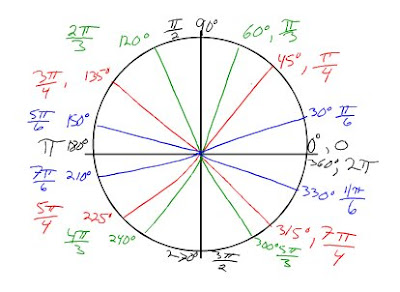
Below is a picture of simple degree values and there Radians beside it. To better understand this picture as it may be hard to look at, I will provide a couple examples. Remember that Pi is equal to 180 degrees.

Example 1: 30 degrees in a circle is Pi/6. That is because 30 degrees is only 1/6 of 180. So if you think about this with Pi, it also contains that same relationship. So a sixth of Pi is Pi/6.

Example 2: You have 225 degrees, which is 5Pi/4 on the circle. 225 degrees is 45 more than 180. Which also means its Pi/4 more if you understand that 45/180 is 1/4. So since it is between Pi and 2 Pi. Add Pi to Pi/4 and you will get 5Pi/4 that is given on the circle. Pi can be added since you have already completed that part of the circle.

----------------------------------------------------------------------------------

Well that's about it. I'm sorry for this late post, and if my information was not at all helpful I'm sorry and will try to make it better for my next post. All these diagrams were slides from our classroom. Also don't forget about the homework that was assigned (Exercise 1: 1-10, Exercise 2: 1-10, and choose 5 from 11-20.) The next person I choose to scribe is Ingrid!